|
||||||||||||||
|
||||||||||||||

|
||||||||||||||
Desperate for WealthAfrican migrants... So much risk in the search for the greener pasture The search for better life in foreign countries continues to entrap Nigerians who seem ever so desperate to just get out to other lands, Damilola Oyedele writes Chinedu Ogechukwu graduated with a second class degree from the University of Benin in 2006, after studying Business Management and Administration. ‘That was not so bad,’ he said to himself as he moved round the city in search of a job. After a year of searching in Edo State, where he resides with his retired parents in their three bedroom bungalow, he decided to move to Lagos. He had borrowed some money from his parents, so settling down in Lagos was a quick one. He rented a room in one of the cities many slums. Everyday, he dreamt of moving to Ikoyi, Lekki, Ajah or at least Palm-grove, but this dream did not materialise for over 14 months of his residency in Lagos. He had no job. 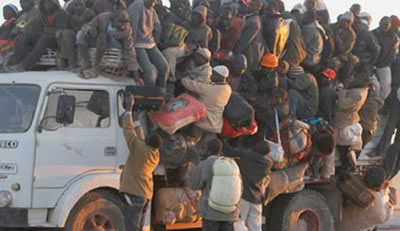 But Chinedu’s friend, Akpan Bright, was living comfortably on the business of importing cars from neighbouring Benin Republic, and Chinedu decided to follow his friend on a business trip. He was however not prepared for the many hassles and uncertainties of this kind of business and he soon ran into debt. He was wondering what to do with himself when his cousin offered him a chance at a ‘better life.’ Someone had come to Nigeria from Spain to take him to a country he had not known before through a path in the desert. Chinedu was overjoyed, but his joy was short-lived as he could not raise $3,000 required to make the trip. His semi-literate parents were not helpful as they were sceptical about a journey abroad through the desert. Although, Chinedu will no longer travel for the rest of his life, little did know that fate was being kind to him. He was saved a harrowing experience. Tola Aboyade was not so lucky. A holder of an Ordinary National Diploma from one of the polytechnics in the South West, he belonged to the group of Nigerians who believe they cannot make much of their life until they travel abroad. He left Nigeria for Libya though the desert, his final destination was Europe. His illiterate parents sold off 3 plots of land in Ilesha to raise the $3500 required to make the journey through the Sahara. They were hopeful; Tola would go to Europe, work hard and lift the family’s fortunes. But Tola came back in 2010 dejected and broken. “I have always been street smart, and I considered myself to be a tough guy, but I had no idea what awaited me on this journey. We travelled through the desert and it was a terrible experience. We first went to Chad; the journey through the desert was in rickety vehicles with little shelter from the elements. We exchanged guides from city to city, and these guides were heartless and showed no mercy to even the women among us. We were not allowed to rest,” he said. By the time he got to Morocco, he had become tired of the journey and he cleverly sneaked away from the group. He went to the Nigerian embassy and asked for help to get back home. He could not stand it anymore; he had seen his female co-travellers openly raped by tuaregs, he had experienced the fear of his bowels being slashed open by rebels in search of money, he had seen fellow travellers abandoned in the desert for being too sick to continue the journey, he had seen immigration officials throw migrants over board into the sea because they do not want to be bothered with the legalities of deporting illegal migrants. The harrowing stories speak of woes; migrants who lost all their money to desert thieves, migrants not able to share food or even water with each other for fear of running out, migrants starving to death, migrants who are abandoned in transit countries especially Mali where most of the females resort to prostitution to survive and their men take to touting and drug peddling. Sources say there are at least 44,000 Nigerians stuck in Mali and can neither go forward nor return home. These men and women believe the streets of Europe are lined with gold. Interestingly, inspite of what they go through, many of them still prefer to go ahead and do degrading jobs in any other country as long as it is not Nigeria. They are assisted by scrupulous characters who pose as agents that can procure visa for clients to almost any part of the world. These agents never tell their clients the dangers associated with such travels or that over 50 percent of the clients do not make it to the ‘promised land’. Smuggling of Migrants (SOM) is more attractive to criminal gangs as there is low risk of detection as members of the syndicates hardly travel these routes with the illegal migrants. They work with corrupt government officials to ensure that the migrants evade border controls, visa and migration regulations. They change routes frequently and establish trans-border syndicates. It is again low risk as they almost never lose any money in the process. A higher percentage of the fees charged are always paid in advance, while just a minimal percentage may be required upon delivery or at a transit location. A migrant who refuses to part with the balance does so at a risk to himself as these syndicates have no patience for such. Thousands die annually on these journeys due to the risks; they die of suffocation in crates and containers, packed like sardines next to toxic materials. Stakeholders continue to raise their voices for awareness to discourage vulnerable Nigerians on the dangers of embarking on such journeys, but the trend continues to rise. Smuggling of Migrants (SOM) is a crime that works hand in hand with Trafficking in Persons (TIP). The two crimes are however for different aims and purposes. Just recently, the National Agency for the prohibition of Trafficking in Persons (NAPTIP) alongside men of the Nigerian police burst a baby selling syndicate where one of the members organise fake marriages with girls who have babies out of wedlock and have been rejected by their families. Headed by one Kingsley Linus, the syndicate already sold off five babies for prices ranging from N400, 000 – N500, 000 before they were apprehended. There have also been cases of children being used in a slave-like condition to pay off debt or to earn money for their families. The International Protocol on Trafficking does not require countries to use the United Nations definition on the crime; rather they should modify the language in a manner that would suit their domestic environment and its trend of trafficking. The domestication should however involve criminalisation of attempts to commit a trafficking offence, participation as an accomplice in such an offence and organizing or directing others to commit trafficking. Human traffickers remain ruthless in their activities to protect their business which is estimated to be worth $11 billion globally. For them, the risks are higher than for pure human smugglers. The major difference between smuggling of migrants and trafficking in persons is that in the case of SOM, the agent is done with the migrant once the migrant reaches his destination, but in TIP, it is usually for one form of exploitation or the other. It is however easy that a person being smuggled becomes a victim of human trafficking. Also in human trafficking, the victim is indebted to the traffickers for years. Sometimes, the trafficker decides to sell off a victim to another trafficker and make a hug profit. Although it is mostly for sexual exploitation, the victims are also used as slaves on farms and quarries. When the crime becomes trans-border, there is a higher risk of the victim being used as a drug peddler or have his/her organs harvested and sold off on the black market. Trafficking in Persons can occur inside a country, within a state while SOM involves crossing national borders. Also in many instances, victims of TIP are not aware of the real reason they are being trafficked while the illegal immigrant is a willing accomplice. It has therefore become necessary for more international and cross border collaboration to fight the twin scourges. The United Nations Office on Drug and Crime (UNODC) as the UN agency responsible for fighting the twin scourges has decided to join forces with the National Agency for the Prohibition of Trafficking in Persons (NAPTIP), and the International Organisation for Migration (IOM) to halt the rising trend in Nigeria. Together, the organisations decided to campaign against the trend with a positive approach by projecting a positive mantra “I Am Priceless” to raise a sense of self esteem in vulnerable people that their worth, transcends being smuggled or trafficked. The 4.8 million Euros project is being funded by the European Union Delegation to Nigeria. At the launch in Abuja recently, the Deputy Head of the EU Delegation to Nigeria, Mr. Kazimierz Romanski said the money is to assist the efforts of the Nigerian government through intensified campaign targeted at young people including those at the grassroots. The Attorney General of the Federation (AGF) and Minister of Justice, Mr. Mohammed Bello Adoke delivering the keynote address said the government is concerned about the twin scourge of TIP and SOM and the negativity it causes to the image of the country. He added that the government has taken note of the issues raised in the US Report and is already working to address them. “We are convening an inter-ministerial committee of all stakeholders, providing special training for law enforcement agencies and I am happy to inform you that the Nigeria Police now has a TIP and SOM module in its curriculum,” he said. The AGF said various policies and key initiatives aimed at reducing poverty are being implemented by the Federal Government. The Country Representative of the UNODC, Ms. Mariam Sissoko disclosed that the launch of the nationwide campaign would take place in six states in the country: Anambra, Benue, cross River, Edo, Lagos and Niger to strengthen national capacity to better combat the scourges and maximise the development potential of trafficking. “It is meant to expose the antics of people who deceive the vulnerable with false promises of green pastures, and to appeal to parents, who although they know what may happen to their wards, choose to close their eyes out of desperation, poverty and greed,” she added. Popular Nigerian actress and producer, Ms. Joke Silva and hip-hop sensation, Jude Abanga, popularly known as MI, were unveiled as UNODC Goodwill Ambassadors against Trafficking. Ms. Silva who also served as compere disclosed that she is already working with trafficked young women who were rescued to assist in their rehabilitation and re-introduction back to society. Some of the rescued women, she said, are already enrolled in school and are doing well in their studies. Others are receiving vocational training in sewing, hairdressing and other arts. MI disclosed that he had left the shores on Nigeria over a decade ago with a mind that he was not returning. “But after a while, I wanted to come back home, I am more comfortable here,” he told the audience after performing one of his most popular songs one naira love. |
||||||||||||||
|
| ||||||||||||||